
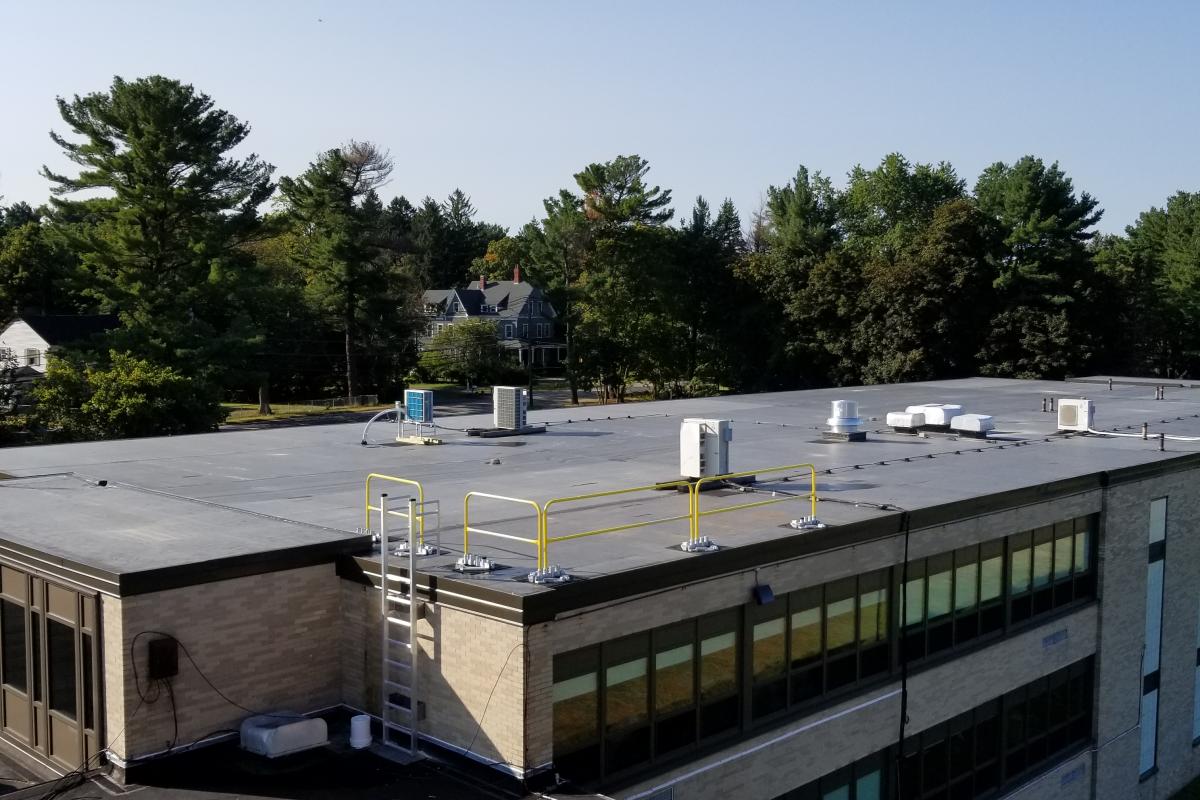
Government and Municipal Building Roofing roof planning built from the roof condition.
Commercial roof scope, documentation, access planning, and weather-aware scheduling for acrylic roof coatings.
Washington, D.C. represents the most concentrated environment of government buildings in the United States, encompassing federal agencies, the District of Columbia's own municipal facilities, embassies, quasi-governmental institutions, and the capitol complex itself — though the federal installations fall under separate procurement authorities from D.C. municipal work. Commercial roofing contractors operating in the District must understand a two-track government market: the D.C. government's own facilities managed through the Department of General Services, and the vast federal inventory managed through the General Services Administration and individual agency facilities programs. Both tracks offer substantial roofing opportunities, but they operate through different procurement mechanisms, contractor qualification requirements, and compliance obligations that require distinct operational preparation.
The D.C. Department of General Services manages the District's portfolio of government-owned facilities, including the John A. Wilson Building — the District's city hall on Pennsylvania Avenue — the Metropolitan Police Department headquarters, the D.C. Fire and Emergency Medical Services headquarters and station network, and the District's public library system driven by the Martin Luther King Jr. Memorial Library. Roofing contracts for D.C. government buildings are procured through the D.C. Office of Contracting and Procurement, following the District of Columbia Procurement Practices Reform Act. The PPRA establishes competitive sealed bidding, competitive sealed proposals, and other authorized methods for different contract types, with specific documentation, advertising, and evaluation requirements that contractors must follow precisely to submit a compliant bid or proposal.
Davis-Bacon prevailing wage requirements apply broadly across Washington, D.C. government roofing work. Federal Davis-Bacon rates for the Washington Metropolitan Area are among the highest in the country, reflecting the region's construction labor costs and union density, and the D.C. Government has its own parallel prevailing wage requirements under the D.C. Prevailing Wage law that apply to District-funded construction. Roofing contractors working on D.C. government buildings must maintain meticulous certified payroll records, post required notices at the job site, and submit payroll documentation to the contracting agency on required intervals. The D.C. Department of Employment Services enforces prevailing wage compliance on District-funded projects, and the federal contracting agencies conduct their own Davis-Bacon compliance oversight on federally funded work in the District.
The D.C. Public Library system's renovation program, which includes both the restored Martin Luther King Jr. Memorial Library — a Mies van der Rohe-designed landmark that was extensively renovated in recent years — and the network of neighborhood branch libraries throughout the city, presents roofing challenges ranging from landmark preservation at the MLK building to standard municipal re-roofing at branches. Public library roofing in D.C. involves the D.C. Department of General Services as owner, the library system as occupant with programmatic requirements, and community stakeholders who follow renovation projects closely in a city where civic architecture carries cultural significance. Contractors should expect multiple rounds of design review, community liaison meetings, and coordination with the library's facilities and IT staff on construction phasing to protect digital infrastructure from construction vibration and moisture.
The District of Columbia's aggressive sustainability commitments, embedded in the Clean Energy DC Omnibus Amendment Act and the District's Building Energy Performance Standards, impose energy performance requirements on existing buildings above certain sizes that can affect roofing decisions at government facilities. Large D.C. government buildings subject to BEPS requirements must meet energy performance benchmarks on multi-year compliance cycles, and roof system performance — both insulation value and solar reflectance — contributes to the building's overall energy score. D.C. agencies managing large facilities have incorporated roof replacement into broader building decarbonization strategies, sometimes bundling roofing with HVAC upgrades and solar installations in single project packages that require a general contractor or construction manager rather than a standalone roofing contract.
Bonding capacity is a practical constraint for D.C. government roofing work given the scale of contracts in the District. A single roof replacement on a major federal building or a D.C. government campus can reach seven-figure contract values, and roofing contractors whose surety line does not support bonds at those values are functionally excluded from the market regardless of their technical qualifications. D.C. government and federal solicitations typically include a bond capacity certification requirement, and some solicitations set minimum bonding capacity thresholds that contractors must demonstrate. Building bonding capacity requires time and documented financial performance, so contractors planning to expand into larger D.C. government projects should begin the conversation with their surety well before the target solicitation is posted.
The Metropolitan Police Department's district station network, scattered across D.C.'s neighborhoods from Brightwood to Anacostia, includes facilities with a wide range of ages and roof conditions. MPD station roof replacements follow D.C. OCP procurement procedures, and coordination with police district commanders is essential to schedule work phases that maintain operational security requirements — particularly around areas where rooftop access could compromise surveillance or communication infrastructure. Contractors who have developed experience with the operational sensitivity of public safety facilities, and who demonstrate in their proposals that they understand this sensitivity, distinguish themselves from lower-cost bidders whose project execution experience does not extend to occupied government buildings.
- Commercial Roof Inspection
- Roof Drains Scuppers
- Self Storage Roofing
- Commercial Reroofing
- KEE Single Ply Roofing
- Storm Damage Roof Repair
- Auto Dealership Roofing
- Preventive Roof Maintenance