
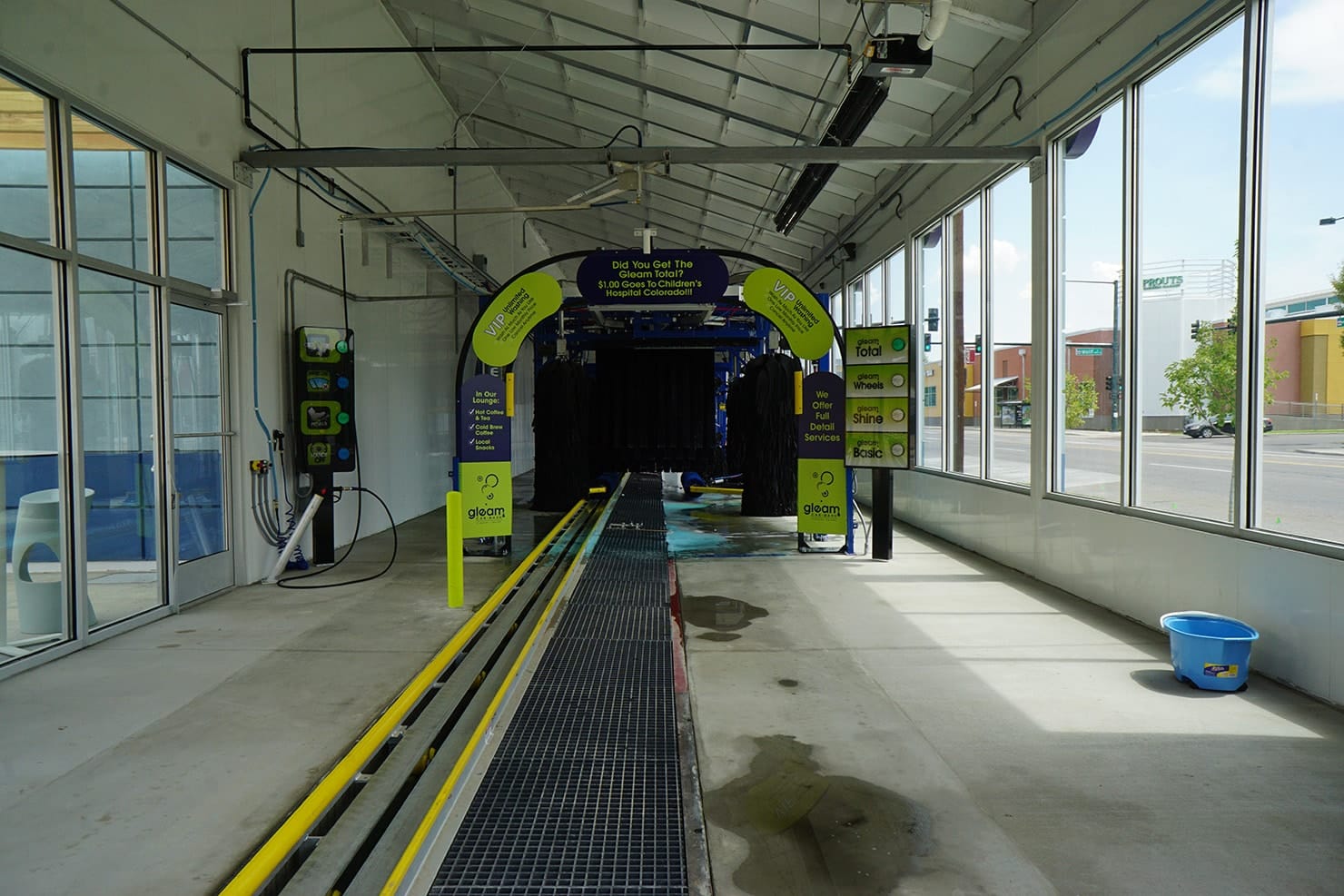
Car Wash Roofing roof planning built from the roof condition.
Roofing built for the wettest building on the block
A car wash punishes its roof from the inside out, and that is the part most contractors miss when they walk a property along Georgia Avenue, Bladensburg Road, or out toward the New York Avenue corridor where so many of DC's high-volume tunnels sit. The cars and the weather are the visible story. The real story is happening overhead inside the wash bay, where hot water, detergent mist, tire-dressing aerosol, and drying-agent vapor rise off the equipment all day and condense against the underside of the deck. We build car wash roofs around that interior climate first, because it is the thing that quietly destroys an assembly long before a storm ever touches the surface.
What the wash bay does to a roof deck
The wash bay enclosure is the highest-risk roof zone on any car wash, and it fails in ways that a normal commercial roof never does. Heated, chemically loaded air rises and meets the cooler deck surface, and the moisture drops out as condensation on the structural metal and the insulation facer. Over a season or two that hidden wetting corrodes fasteners from underneath, delaminates insulation facers, and rusts steel deck flutes that look perfectly fine from the parking lot. By the time a stain shows up on the bay ceiling, the damage is years deep.
Alkaline detergents and the surfactants in modern wash chemistry are also hard on the membrane itself. TPO, EPDM, and PVC each react differently to that exposure, and the standard manufacturer warranty almost always carries a chemical-exposure exclusion buried in the fine print. We specify with that exclusion in mind. For the active tunnel bay we lean toward a fully adhered PVC because its plasticizer chemistry holds up to alkaline detergent and wax residue far better than TPO or EPDM over the long run, and the adhered attachment kills the membrane flutter that tunnel air pressure creates against a mechanically fastened field.
Ventilation is the other half of the fix. A wash bay roof needs exhaust capacity sized to actually pull the steam and vapor out before it condenses, paired with a vapor-control approach in the assembly that does not trap moisture between layers. We have seen plenty of DC washes where a brand-new membrane went over a deck that was already corroding because nobody addressed the air. Membrane alone does not solve a humidity problem. We treat the bay as a moisture system, not just a surface to be covered.
Canopies, vacuum islands, and the equipment room
Past the tunnel, a car wash is really several small roofs with different jobs. The vacuum-island canopies on the exit side take vehicle exhaust, tire-shine overspray, and constant outdoor thermal cycling, and the connection where a canopy ties back into the main building is the single most common chronic leak we find on express properties in the District. Those transitions move, the original flashing was usually undersized, and water finds the gap. We treat every canopy-to-building joint and every canopy drain connection as its own detail rather than assuming the main-roof system carries over.
The equipment room and the customer lobby roofs are comparatively easy, but they sit right next to the most hostile zone on the property, so detailing at the boundary between bay and non-bay matters. The exhaust fans that clear the tunnel punch through with oversized curbs that see continuous airflow and vapor, and standard HVAC curb flashing is not built for that duty. We flash each penetration to match what it actually carries, then document it so the next inspection has a baseline.
Working around a wash that never closes
Car washes in the DC area run seven days a week through most of the year, and the busiest hours are exactly when the weather is nice enough to roof. We plan around that instead of fighting it. Tunnel-bay work that requires opening the envelope gets scheduled into the early-morning or late-evening closed window, dried in before the next open. External building, canopy, and vacuum-island work can usually proceed during operating hours with traffic control that keeps cars clear of the staging zone. The operator keeps washing cars; we keep the roof watertight through every phase.
Common questions from DC car wash owners
- Why PVC instead of TPO over the tunnel? PVC's plasticizer chemistry resists the alkaline detergents and wax compounds in commercial wash operations better than TPO or EPDM. Fully adhered, it also eliminates the membrane flutter that tunnel air pressure causes on a fastened field. We reserve TPO for the lower-exposure lobby and equipment-room sections where it performs fine.
- Will my warranty actually cover chemical exposure? Not automatically. Most single-ply warranties exclude it. We confirm your specific chemical program against the manufacturer's compatibility data and pursue a chemical-exposure or car-wash-rated warranty option where one exists, so the coverage matches the building.
- My ceiling keeps staining even though the roof is newer. Why? That is usually interior condensation, not a surface leak. If the bay exhaust is undersized or the assembly traps vapor, moisture condenses on the deck and drips back down. We diagnose the air and the assembly before assuming the membrane is at fault.
- Can you handle the vacuum canopies and the drains too? Yes. Canopy membrane or panel replacement, canopy-to-building flashing, and gutter and downspout work are all part of how we scope a car wash, because those transitions leak more often than the main roof does.
- Can you work without shutting us down? In most cases, yes. Tunnel work goes into your closed hours; exterior and canopy work proceeds during business hours with traffic control. Each section is dried in before you reopen.