
Movie Theater & Cinema Roofing roof planning built from the roof condition.
Big roofs over dark rooms full of paying customers
A cinema is a deceptively hard building to roof, and the DC market has the full range of them, from the multiplexes anchoring retail centers out in the Maryland and Virginia suburbs to the renovated single-screen and arthouse rooms that still operate in neighborhoods like Penn Quarter and along the U Street and Georgia Avenue corridors. The thing that makes a theater different from the strip retail it often sits next to is what is happening structurally overhead. Each auditorium is a large clear-span room with no interior columns, which means the roof carries spans that a template built for a row of shops was never meant to handle.
An eight-to-twelve-screen multiplex can run auditorium roof spans of 80 to 150 feet, and those long-span decks deflect under load in ways that change how the membrane and insulation have to be attached. We do not import a fastening pattern from a flat retail roof and hope it transfers. We spec the fastener density and insulation attachment off the actual deck type and the actual span, because getting that wrong on a long-span bay shows up later as seam stress and fastener back-out concentrated right where the deck moves most.
The rooftop is as busy as a hospital
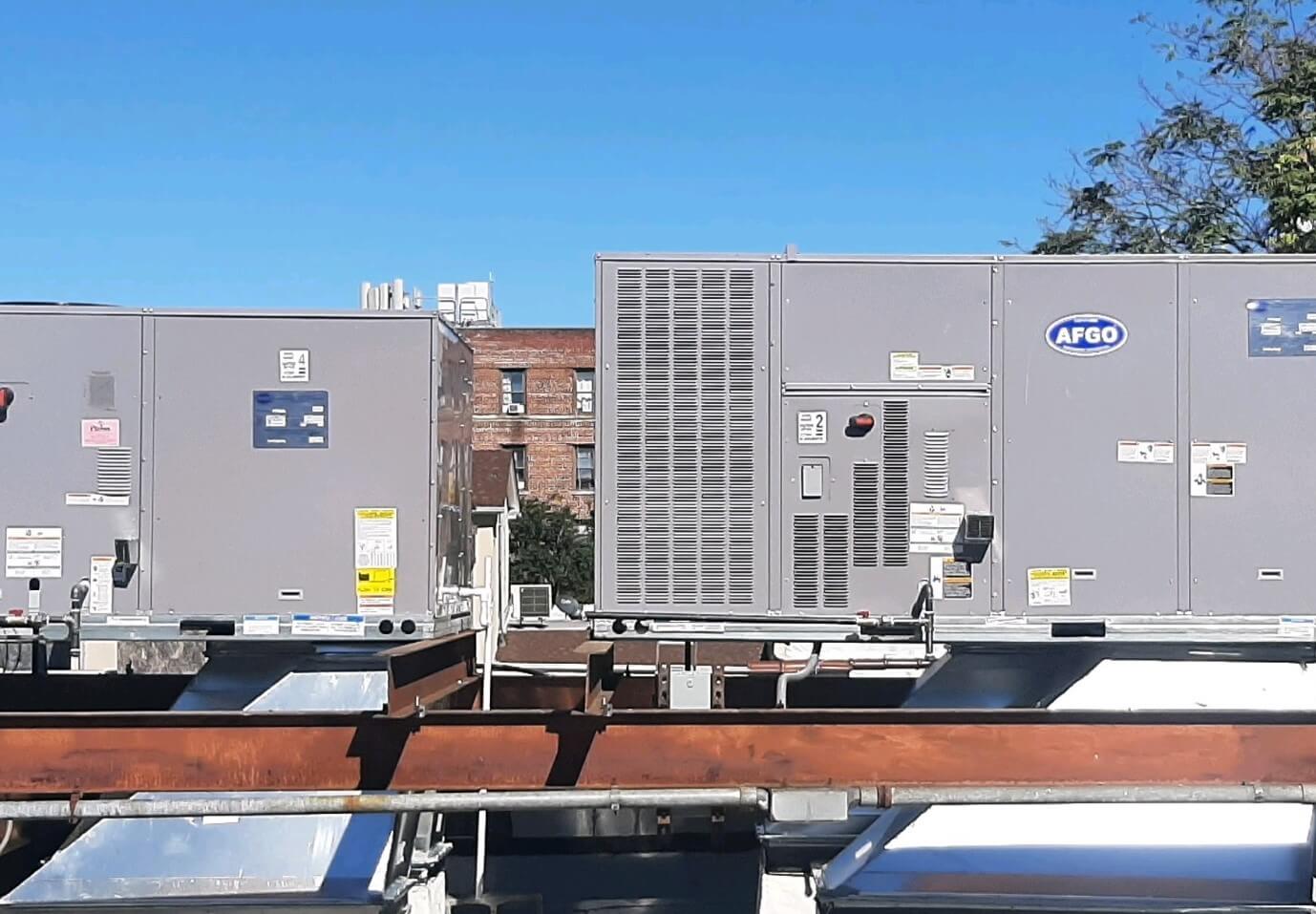
Sit a cinema's mechanical load on the roof and it rivals far more complex buildings. Each auditorium typically needs dedicated HVAC, often a rooftop unit per screen sized for a packed house, plus concession exhaust, boiler venting for the lobby, and condensers for the walk-in coolers behind the food service. The result is a dense, concentrated cluster of curbs, duct penetrations, and conduit runs across the roof. Every one of those is flashed and documented individually before new membrane goes over it, because the penetration field is where a theater roof actually leaks, not the open membrane between the units.
High occupancy is the reason all that HVAC is up there in the first place, and it ties directly to insulation and sound. A full auditorium generates significant cooling demand, and the roof assembly is part of both the thermal envelope and the acoustic separation between a loud room and the world outside. We treat the insulation as performing double duty, thermal and sound, rather than as a commodity layer, and we keep that in mind when we recommend a recover versus a full replacement.
Knowing the deck before we touch it
Cinema construction usually runs a steel deck or a concrete deck over structural steel, and the two substrates call for different attachment strategies. Steel deck takes mechanical attachment directly; concrete deck points us toward adhered or, where loads allow, ballasted systems. We do not assume which one is up there. On a theater reroof we start with a core sample to confirm the existing insulation layers, check moisture content, and establish the total weight-in-place before recommending a recover or a tear-off, because a wrong guess about the assembly is the difference between a clean recover and a structural surprise mid-project.
For the system itself, a 60-mil or 80-mil TPO mechanically attached over tapered polyiso is the common cinema specification in this market. The tapered insulation corrects the drainage problems that accumulate over decades of flat theater roofs, the white membrane satisfies the cool-roof requirements most jurisdictions now apply at reroof, and we add reinforced walkway pads along the service routes to the rooftop units so the membrane survives the foot traffic that maintaining all that HVAC creates.
Drainage, sound, and the things that ruin a showing
Flat theater roofs pond, and on a cinema that is a worse problem than it sounds. The large low-slope auditorium decks were often built with minimal slope to begin with, and after decades of insulation compression and a few rounds of recover work, water sits in broad shallow lakes between the rooftop units. Ponding shortens membrane life, adds load to a long-span deck, and gives any marginal seam or penetration a standing reservoir to work through. Correcting the drainage with tapered insulation is usually the single most valuable part of a cinema reroof, which is why we design the slope to move water to the drains and overflow scuppers rather than just laying new membrane over the same flat pan.
Sound is the other consideration that makes a theater roof different. The whole point of the building is controlled acoustics in a dark room, and the roof assembly is part of the barrier between a loud soundtrack and the neighborhood, and between a hard rain and the audience below. A poorly insulated or loosely detailed deck lets drumming rain become audible during quiet scenes, and a thin assembly undercuts the sound separation the auditorium was designed for. We treat the insulation and the membrane attachment as part of the acoustic envelope, not just the weather envelope, so the room stays as quiet as the projectionist needs it to be.
Theaters run from early afternoon into the late night, seven days a week, which puts them closer to a 24-hour operation than a daytime business. We plan the work around the screening schedule. Tear-off and dry-in are sequenced so every section is watertight before the evening shows begin, HVAC shutdowns for curb or penetration work are coordinated with facilities management, and staging stays clear of the entries, the marquee, and the evening foot traffic. The marquee and entry-canopy attachments deserve their own mention: those penetration and transition points are a classic chronic-leak source on older theaters, and we re-flash them as part of the project rather than leaving them for the next contractor.
Common questions from DC cinema operators
- What system do you usually put on a multiplex? A 60-mil or 80-mil TPO mechanically attached over tapered polyiso. The taper fixes long-standing drainage issues, the white membrane meets cool-roof code, and walkway pads protect the membrane along HVAC service routes.
- How do you handle the long-span auditorium decks? We verify the deck type and gauge, then set fastener patterns and run pull-out testing appropriate to the rib depth. Where deflection is a concern we may use an adhered or hybrid system to avoid concentrating point loads at the seams.
- Can you work without canceling showings? Yes. We sequence tear-off and dry-in so each section is watertight before evening screenings, and we coordinate any HVAC shutdowns with your facilities team.
- How is a cinema reroof priced? Per roof square, based on membrane spec, existing assembly condition, penetration density, and access. Most multiplex reroofs include tapered insulation, which adds cost but extends membrane life by ending ponding. We quote fixed price after a roof walk and core review.
- Do you address the marquee and entry canopies? Yes. Marquee supports, canopy attachments, and canopy-to-building transitions are treated as individual flashing items and re-flashed, since they are a frequent leak source on older theaters.