
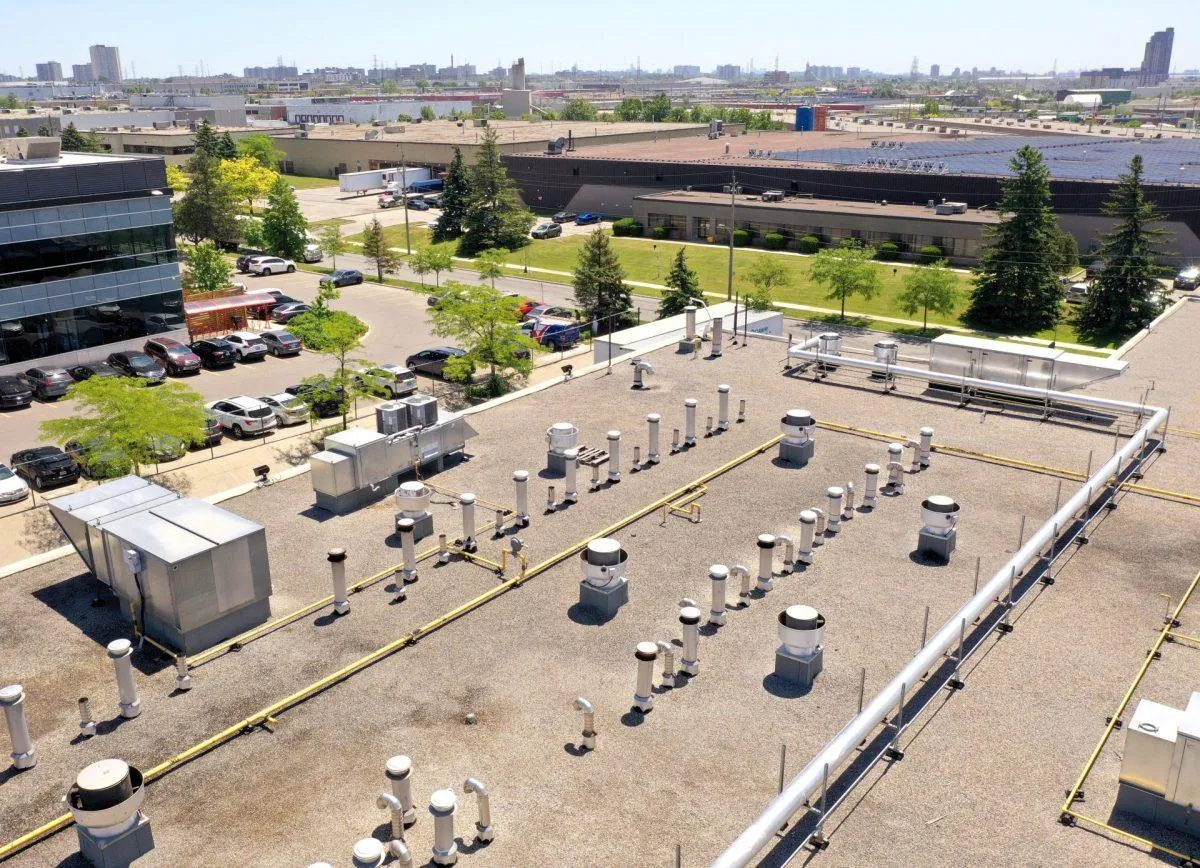
Food Processing Roofing roof planning built from the roof condition.
Roofing where a leak is a recall, not a repair
Food and beverage production has carved out real space in the DC region, from commissary kitchens and bakeries feeding the District's restaurant scene to bottling, packaging, and cold-chain operations spread across the industrial parks off Pennsylvania Avenue in Capitol Heights, the warehouse belt along I-95 in Prince George's County, and the Beltway-adjacent food hubs in Landover and Hyattsville. What separates these buildings from any other commercial roof is the stakes of failure. Water finding its way over an active line is not a maintenance ticket; it is a potential food-safety event that puts product on hold and brings the plant's quality team and possibly a regulator into the conversation. We scope food-processing roofs to remove that risk up front rather than respond to it after the fact.
The interior environment is the second thing that sets these roofs apart, and it works the assembly hard. High-volume washdown, cooking steam, and the humidity that comes with sanitation cycles load the air with moisture, while refrigeration and process equipment stack heavy concentrated loads onto the deck. That combination, hot wet air below and significant weight up top, is exactly the recipe that destroys an assembly from the inside while the surface still looks intact.
Membrane and materials start with the food-safety plan
On a USDA- or FDA-regulated floor, the roofing spec does not begin with a product catalog; it begins with what is acceptable over a food-contact environment. Not every commercial membrane qualifies. White TPO and PVC single-ply are generally acceptable over enclosed processing areas, but the specific formulation and installation method have to be confirmed against the plant's food-safety plan before we commit. The same review extends to the parts nobody thinks about: adhesives, primers, and sealants used in flashing details, many of which carry solvents that simply are not allowed in a production environment. We verify the whole material stack with the plant's QA group, not just the membrane.
Reflectivity matters here too, and not only for energy code. A white membrane keeps rooftop surface temperatures down, which eases the load on the refrigeration systems that dominate these buildings and helps hold a stable thermal environment over chill and freezer spaces. We factor that into the recommendation rather than treating cool-roof selection as an afterthought.
Refrigerated spaces and the condensation trap
The roof over a freezer room, blast-freeze area, or chill room is the most technically demanding part of a food-processing building. The cold space below and the warm humid air above create a powerful vapor drive into the assembly, and if the vapor control and insulation are not designed for it, moisture condenses inside the roof and rots the deck and insulation from within, with no leak ever appearing on the surface. By the time anyone notices, the structural deck may be corroding. We design the tapered insulation and vapor-control approach over refrigerated areas around the actual operating temperatures and the local vapor-drive direction, and we keep drainage moving to scuppers or interior drains so ponding never adds thermal load over a freezer.
Rooftop loads and sanitation hardware nobody plans for
Processing buildings carry more weight on the roof than their footprint suggests. Large refrigeration condensers and evaporative units, dust collectors, makeup-air handlers sized for high air-change rates, and the structural support steel that hangs sanitary piping and conveyor lines below all concentrate load onto the deck, and that load grows every time the plant adds a line. We confirm the existing deck capacity before we add insulation thickness or sign off on new equipment curbs, because a deck that was fine for the original build is not automatically fine after two decades of process expansion. Where the structure is near its limit, we adjust the assembly rather than assume the margin is there.
The penetration field on a food plant is also unusually dense and unusually wet. Sanitary vents, exhaust stacks carrying cooking and washdown vapor, refrigeration lines, and the pipe penetrations feeding clean-in-place systems all pierce the membrane in clusters, and each one sits in an environment where humidity is constantly trying to find a way in. We flash every penetration to the duty it actually carries and detail the curbs to shed water cleanly, because in a building where the air below is this saturated, a marginal penetration detail does not stay marginal for long. Edge metal and perimeter terminations get the same attention, since wind-driven rain at the perimeter is a common entry point that interior-focused inspections miss entirely.
Sequencing around a floor that runs three shifts
Most DC-area processors run continuously, with the weekly sanitation window as the only stretch when the floor is down. That window governs the roofing schedule. Any work that opens the envelope over an active production area is confined to sanitation periods or planned shutdowns, with the production team and QA manager confirming the floor is cleaned and protected before we start and dried in before the line restarts. Work over refrigerated zones is coordinated with the refrigeration crew so nothing we do interrupts the cold chain. We phase the project around the plant's clock, not the other way around, and we keep an emergency dry-in protocol on call because a leak over a running line cannot wait until morning.
Common questions from DC food and beverage plants
- Can you use any membrane over our production floor? No. USDA- and FDA-regulated areas require the membrane, adhesives, primers, and sealants to be confirmed acceptable for food production before they go on. We verify the full material stack with your QA team against your food-safety plan.
- When can you actually work over an active line? During your weekly sanitation window or a planned shutdown. We coordinate with the facilities manager and QA so the floor is protected before we open the envelope and watertight again before the line restarts.
- How do you keep water off the freezer rooms? Tapered insulation directs drainage to perimeter scuppers or interior drains so nothing ponds over a refrigerated space. Ponding adds thermal load and accelerates deck corrosion, so the drainage design is grounded in the refrigeration layout.
- What happens if we get a leak during production? Our food-processing emergency protocol includes 24-hour contact, priority mobilization for temporary dry-in, and documentation support for your incident reporting. The first call goes to your QA and facilities team for product-hold evaluation.
- Can you support USDA and FDA inspections? Yes. Roof condition is a standard inspection item. We provide condition documentation and repair records your QA managers can produce to show proactive maintenance.